
A Life Slowly Coming Into Focus
PART 2/10 — How to Become Easy to Love
My grandmother, on my dad’s side, used to say I was “mature when I was born,” which is honestly a very charming way to describe a child who already felt responsible for the mood in the room. Tell me how a newborn can ever live up to carrying that kind of pressure???
I became useful early.
Helpful. Funny. Productive. Memorable.
Which sounds very noble until you realize it may have also been a deeply subconscious strategy for survival.
In elementary school, I spent recess helping in the special ed classroom because I liked feeling needed. Or maybe because I liked feeling chosen. The special ed kids had a different recess schedule than the rest of us, so while everybody else was outside building friendships on the monkey bars and negotiating the politics of four square, I was inside helping.
Back in my regular classroom, I helped a Spanish-speaking girl named Ana learn basic English words using crayons, calendars, colors, and numbers while the other kids were still finishing their assignments. This was before ESL programs really existed in California public schools, so I just became the tiny unpaid classroom intern apparently.
I still can’t tell what the real story was there.
Was I smart?
Or just fast?
Was I genuinely gifted?
Or was I desperately trying to prove I had something valuable to offer adults?
Did I help because I loved connecting with people?
Or because my teacher realized that if she gave me extra responsibilities, I’d stay busy and regulated?
Maybe all of it is true.
Because that pattern followed me into adulthood with terrifying consistency:
get the assignment,
finish quickly,
ask for more work,
be useful,
be praised,
repeat.
Meanwhile the kids who somehow seemed comfortable just existing appeared perfectly fine completing one task and then relaxing with Lunchables and self-worth.
I truly cannot relate.
I wanted teachers to see me as mature. Capable. Kind.
I was the first kid trusted to run the snack cart during recess before students were even technically allowed to do that sort of thing. I learned how to make change in quarters like a tiny deeply-invested cashier with something to prove.
Nothing makes a child feel more important than being handed responsibility before anyone else. Give a validation-starved overachiever a clipboard and suddenly she thinks she’s regional management.
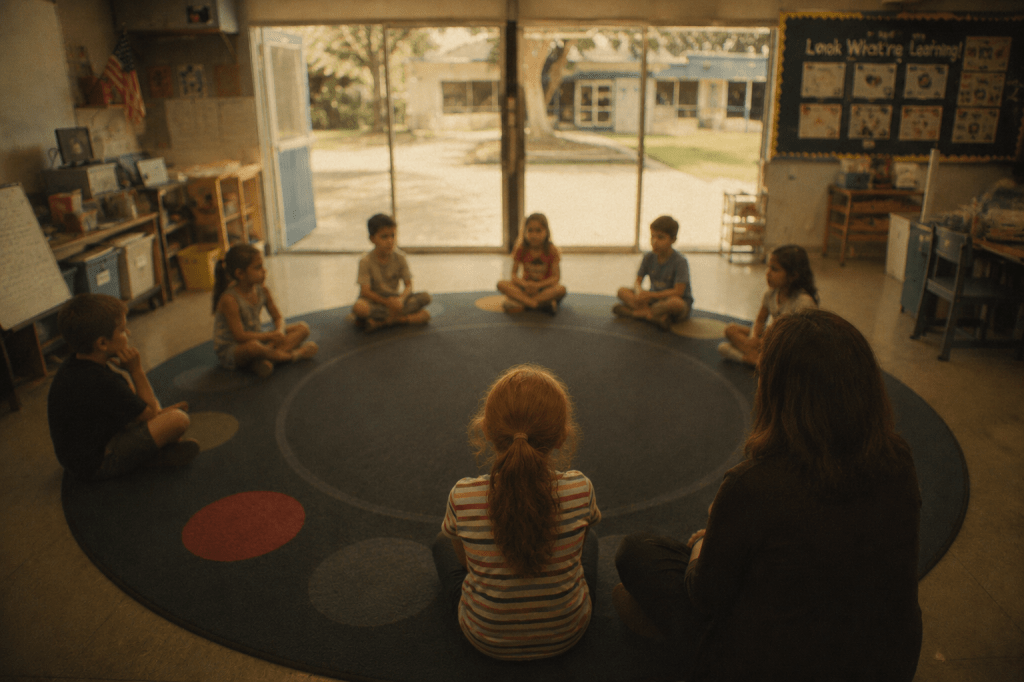
While still in elementary school, I got placed into a weekly group where we sat in a circle and talked about feelings. Not a class. Not detention. Just… a group. I remember looking around the room at the other kids and thinking they must have brought me in there to help. I just thought it was fun to get out of class and sit with kids who felt different in ways I couldn’t explain yet.
Looking back now, I realize the school probably wasn’t asking me to help the struggling kids.
I was one of the struggling kids.
Nobody explained that part to me.
Maybe they tried.
Maybe they saw a loud little redheaded girl who felt everything at full volume and recognized something wasn’t fully okay. Maybe they understood there were some situations where reaching out to a household wouldn’t magically create stability. Maybe they were trying to help in the only way they knew how.
I’ll never really know.
I think kids deserve context, though. Why wouldn’t you tell someone why they’re in the room? Maybe that’s part of why I became an adult constantly scanning for hidden meanings and unspoken tension. Nobody ever explained the script, so I learned to study the audience instead.
Nobody ever explained the script, so I learned to study the audience instead.
My generation doesn’t have receipts for childhood.
No archived text messages.
No endless camera rolls.
No digital proof of who showed up and who didn’t.
Just fragments.
Snapshots.
The blurry disposable-camera version of memory where everyone’s eyes are half closed and somebody’s thumb is covering the corner of the lens while somebody’s aunt yells, “JUST TAKE THE PICTURE, DEBBIE.”
Which honestly might explain why I became obsessed with photography later.
I loved pictures before I understood why.
The tiny 110 camera.
The spinning film wheel.
The waiting for the roll to come back developed.
But more than anything, I loved the background details. The things happening behind the main subject. Somebody laughing off to the side. Somebody looking lonely while everyone else smiled. Tiny human truths accidentally captured in the frame.
Which, in hindsight, feels aggressively symbolic.
What I do know is that I learned very early how to become the version of myself that adults rewarded.
I learned very early how to become the version of myself that adults rewarded.
I won a writing contest in third grade about why I wanted to meet author Audrey Wood. I got the signed book, the applause, and the feeling that maybe being creative could make people proud of me.
That probably should not have hit as hard as it did for an eight-year-old, but here we are.
By junior high, my personality had evolved into what I can only describe as feral overachiever theater kid energy for someone who was actually too scared to join theater.
I probably could have been a theater kid if I’d had more confidence, but I was too afraid of what would happen if I lost control. Marching band worked because there were rules. Rhythm. Structure. You could be overwhelming there and people just called it passion and handed you cymbals.
Every morning in seventh grade, I voluntarily visited a teacher I didn’t even have just to tell him a joke before class started. I fake married my eighth grade science teacher in front of an entire classroom. There was a fake engagement. A fake ceremony. Wedding attendants. A ring bearer.
Public schools in the 90s really believed in giving deeply theatrical children unlimited creative freedom and absolutely no adult supervision.
The funniest part is that my science teacher was apparently having a side relationship with the school librarian at the time and eventually left his wife and married her after I left junior high. Which means technically my fake marriage scandal aged shockingly well.
At one point, his actual son, who was only a year younger than me, danced with me at a school dance and joked that he wanted to dance with his future stepmom.
Please imagine this entire storyline happening in a current middle school and tell me we wouldn’t all be sitting in mediation with at least three district administrators, two angry PTA moms, and somebody threatening legal action before lunch.
The 90s were absolutely feral.
And somehow underneath all of it, I was still just a little girl trying to figure out how to be wanted.
That’s the part that’s hard to explain without sounding either too dramatic or not dramatic enough.
Because none of this felt strange to me then.
Not the fake marriage.
Not the constant performing.
Not the obsession with attention.
Not the way I kept constructing versions of myself that would make people laugh, notice me, choose me, remember me.
I was the original Meredith Grey.
Pick me.
Choose me.
Love me.
It all felt normal.
Or at least normal enough for a kid who had already figured out that being entertaining got a much warmer reaction from the world than being vulnerable.
Being entertaining got a much warmer reaction from the world than being vulnerable.
In eighth grade, as part of an ongoing joke, I covered my seventh grade English teacher’s car in plastic wrap and she retaliated by pulling me out of class just to “serve” me a fake blue referral she had created specifically to scare me.
Which is commitment to a bit on a level I can only deeply respect now as an adult.
Apparently that moment was also the first time my husband ever saw me because he was sitting in her classroom watching me get fake-disciplined like some unhinged after-school special character.
Which, in hindsight, feels less like a first impression and more like a warning label.
I chose electives like I was accidentally building a personal brand before children were supposed to have those.
Home economics teacher’s aide in seventh grade. TV media in eighth. Video yearbook editor. I directed concert recordings like a tiny crazy unstable Barbara Walters with access to a tripod.
Junior high honestly felt more professional than adulthood does now.
I joined color guard in high school at first because the boy I was either hooking up with or aggressively planning to hook up with was in drumline, and color guard felt drumline adjacent. Like proximity marketing for chaotic teenagers. I really liked to plan. I blame the maturity.
But eventually… two weeks into it… I quit and joined drumline directly because apparently even my teenage romantic strategy had a “cut out the middleman” phase.
That sentence alone probably explains several years of my life.
And if I really dig into it now, I can see the pattern underneath all of it. Trauma has a strange way of stacking itself. One wound reaches for another wound because as long as there’s enough noise, enough chaos, enough performance, you never actually have to expose the original injury underneath it all.
Which, now that I type that out, feels like both a psychological realization and an accidental photography pun.
Very on brand for me, unfortunately.
Eventually I became the first female drum section leader. Then band president. Yes, that is a real position. High school marching band president. Basically student government but sweatier and somehow with even fewer stable people involved.
From the outside, I probably looked confident.
Capable.
Funny.
Creative.
Leader-ish.
But internally?
I was also the girl who got teased constantly.
The girl who overreacted.
The girl who felt embarrassed after exploding but didn’t know how to stop doing it.
The girl who always seemed like too much for the room.
I remember one boy in junior high asking me why I wore shorts if I “wasn’t even tan.”
And just like that, I stopped wearing shorts.
People love pretending words don’t matter right up until they become the inner voice you carry around for twenty years.
I wasn’t ugly. I know that now.
I was pretty. Skinny. Naturally striking, if we’re being fair about it.
But I didn’t feel beautiful.
And eventually, when enough voices line up against you, you start trying to reconstruct yourself into somebody who won’t get rejected anymore.
Fire-head became brown hair.
Then magenta hair.
Then one extremely unfortunate attempt at blonde that turned partially green.
Being called flat-chested turned into tighter shirts.
Crooked teeth turned into me lying about getting braces and spending an entire week barely opening my mouth so the lie would feel believable.
That’s the kind of stuff girls do when they are desperately trying to become lovable before they even know who they are.
I remember being at a birthday party in elementary school during the chaotic candy-grab aftermath of a piñata. Somebody accidentally stepped on my hand and I completely lost it. Screaming. Crying. Creating a scene big enough that other kids started panicking too.
Looking back now, it feels obvious that I wasn’t reacting to a hand.
I was reacting from a nervous system that never fully felt safe.
I wasn’t reacting to a hand. I was reacting from a nervous system that never fully felt safe.
But kids don’t know how to explain things like that.
So instead, they become:
helpful
or funny
or impressive
or easy
or “good.”
And I got very, very good at being “good.”
That pattern followed me everywhere. School. Relationships. Church. Adulthood.
Especially church.
There is something particularly dangerous about being a naturally approval-seeking person inside environments that heavily reward goodness, helpfulness, sacrifice, and self-denial. I buried entire parts of myself underneath the role of “good girl” because being praised felt safer than being honest.
The image I was projecting was not always who I was actually being.
The image I was projecting was not always who I was actually being.
And underneath all of it was still the same little girl trying to figure out why she felt so angry and wounded all the time while simultaneously becoming the person everyone else seemed to need her to be.
That’s the strange thing about adaptation.
After enough years pass, you stop noticing you’re adapting at all.
You just become excellent at reading applause.
And maybe that’s what I was really chasing all along.
Not attention.
Confirmation.
Proof that if I stayed useful enough, lovable enough, funny enough, spiritually “good” enough, productive enough…
people would keep choosing me.
I spent most of my life desperately wanting to be noticed while simultaneously terrified someone would actually see me clearly.
Looking back now, I think I spent most of my life trying to become the kind of person nobody would abandon.
Helpful enough.
Funny enough.
Talented enough.
“Good” enough.
And the strangest part is that people really did love me.
They just loved versions of me that were performing survival so well that nobody realized I was disappearing underneath them.
Meanwhile, the louder parts of me kept slipping further underneath performance.
Not healed.
Just buried.
The strangest part about becoming who everyone needs is that eventually you forget there was ever a version of you standing still underneath all the spinning.
Maybe that’s why some of us spend our whole lives performing under spotlights while quietly hoping no one notices we’re bleeding behind the sequins.
Because being noticed and being known are two very different things.
Come back for part 3/10 tomorrow: The Women Who Raised Me Without Meaning To
This piece was written under the emotional influence of “Mirrorball” by Taylor Swift. Turns out some of us learned to reflect light long before we learned how to feel safely seen by it.


Leave a comment