
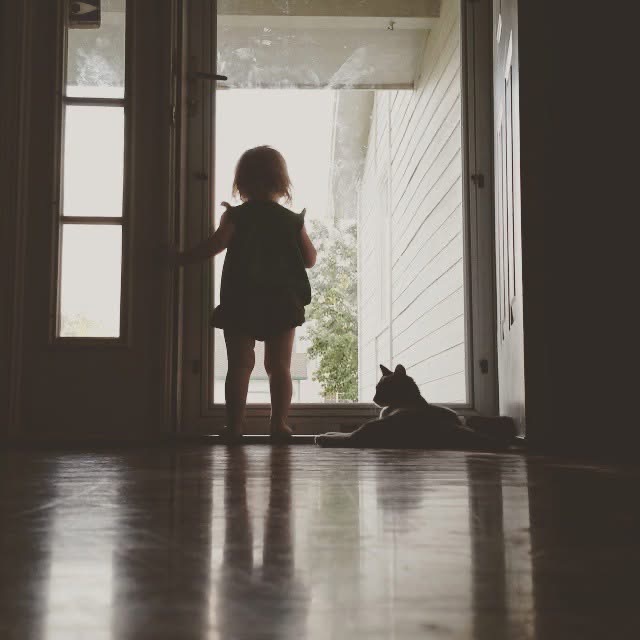
The song I landed on for this story: Seven by Sleeping At Last. Some songs don’t feel like a soundtrack. They feel like permission. This one reminds me that curiosity can be just as powerful as certainty. That questioning isn’t rebellion. Sometimes it’s the beginning of understanding yourself. For a post about inherited rules, childhood memories, and learning to trust my own wiring, this one felt right at home.
Every afternoon, the lights went down and the other kids fell asleep.
I laid on my back staring at the ceiling.
I wasn’t in trouble. I wasn’t being punished. I wasn’t sick. I just wasn’t allowed to sleep.
My mom had told my preschool teacher not to let me nap. If I slept during the day, I wouldn’t go to sleep at night. If I laid on my side or my stomach, I’d drift off. So the rule was simple: keep Sandie awake.
The other kids got blankets.
I didn’t.
A blanket might make me comfortable. Comfort might make me sleepy. Sleep was the thing we were trying to avoid.
So while the other kids curled up under their blankets, I laid on top of my cot staring at the ceiling. No blanket. No pillow. No sleeping.
Just me and an hour of fluorescent-lit consciousness.
I can still see that room.
I can still see Mrs. White.
I can still see the light coming through the windows.
There aren’t many preschool memories that survived forty years.
This one did.
I was three.
Three years old, and somehow my assignment was to stay awake.
The funny thing is, I still hate mornings.
Always have.
I do my best thinking at night. My best writing. My best processing. My best wandering-around-the-house-coming-up-with-ideas energy.
Meanwhile, mornings and I have been in a toxic relationship for more than forty years.
People wake up to alarms and seem fine.
I wake up to alarms and immediately begin negotiations.
Five more minutes.
Ten more minutes.
Maybe if nobody moves, time isn’t real.
Growing up, there were endless stories about how hard it was to wake me up. My mom would tell people I would kick my feet and roll around and refuse to cooperate. Family members joked that I was Snorlax before Pokémon even existed in my world. Sleeping wasn’t just something I did.
Sleeping was something I loved.
Which is why the next part of the story gets even weirder.
By fifth grade, I had a paper route.
Not a cute little “helping out” situation.
A real paper route.
Every morning before school, I folded newspapers, banded newspapers, counted newspapers, loaded newspapers, and delivered newspapers.
I had a giant canvas bag that hung across my shoulders and wrapped around the front and back of my body. It was packed with papers I had folded myself. I knew every house on the route. I knew which paper belonged where. I knew which porch sat farther back from the road and which customers liked their paper tucked in a specific spot.
I could throw a newspaper from my bike and land it on a porch.
I could throw one from a moving car and land it on a porch.
Which is a strange skill for a ten-year-old to possess when you think about it.
If accounts were behind on payments, I was sometimes the one collecting the money too.
Looking back, it sounds like I grew up in 1952.
I didn’t.
This was the late 80s and early 90s.
And every morning, before most adults were even awake, I was out delivering newspapers.
By the time I got to school, I was exhausted.
During silent reading, I would put my book in my lap, rest my head on my desk, and intentionally go to sleep.
Not because I hated reading.
Because I physically could not keep my eyes open.
And yet, none of it felt strange.
Nobody was asking why I was tired.
Nobody was asking whether a ten-year-old needed more sleep.
Nobody seemed concerned that the kid who wasn’t allowed to nap at three was now waking up before dawn at ten.
It was just life.
At least that’s what I thought.
A while back, I was talking with a friend about fight-or-flight and what happens when people finally leave survival mode. Some people collapse into rest. Others suddenly become obsessed with fixing everything.
That second group?
I know them well.
Life settles down and my brain immediately starts making lists.
Write the book.
Fix the house.
Lose the weight.
Organize the garage.
Plan the trip.
Get healthier.
Do better.
Become better.
Improve everything immediately.
During that conversation I said something that stuck with me.
When you’ve been surviving for a long time, your brain starts backlogging rest.
Like a to-do list.
Relax later.
Sleep later.
Recover later.
Feel safe later.
And I started wondering if I’ve spent years calling it drive, discipline, leadership, service, and resilience when some of it was really just survival with better branding.
Because when you’ve spent enough time pushing through exhaustion, rest starts feeling irresponsible.
Recently, I told a therapist that I need to protect my sleep.
She paused and asked a simple question.
“Why do you need to protect your sleep?”
I didn’t tell her about preschool.
I didn’t tell her about the paper route.
I didn’t tell her about decades of feeling like my natural wiring was somehow inconvenient.
But the question stayed with me.
Why do I feel protective of sleep?
Why does it feel valuable enough to guard?
Why does my brain treat it like a scarce resource?
And why, after all these years, do I still remember a room where everyone else got blankets and I didn’t?
I don’t have answers.
What I have is a pattern.
A three-year-old staring at the ceiling.
A ten-year-old delivering newspapers before sunrise.
A teenager falling asleep whenever she could.
A young adult thriving on graveyard shifts because her body finally got to operate on its own clock.
A forty-four-year-old woman still trying to figure out whether she’s been fighting her design her entire life.
That’s the question that interests me.
Not whether anyone was right or wrong.
Not whether my childhood was good or bad.
Not whether anybody meant harm.
I’m interested in the rules.
The ones we inherit.
The ones we absorb.
The ones we never question because they’ve always been there.
Children don’t evaluate systems.
They adapt to them.
Adults explain.
Children believe.
Then one day you wake up and realize you’ve been carrying certain ideas for decades without ever asking whether they belong to you.
Work harder.
Push through.
Stay useful.
Rest later.
Ignore your body.
Keep going.
And eventually a question rises to the surface.
Not angry.
Not bitter.
Just curious.
Who decided that?
And more importantly:
Do I still agree?


Leave a comment